Alexander Glaser
INTRODUCTION
The end of the Cold War has created a new climate
for international action to eliminate nuclear weapons, a new opportunity.
It must be exploited quickly or it will be lost.
Canberra Commission, 1996
|
Less than a decade ago, the vision of complete and irreversible nuclear disarmament appeared as a consequent ultimate outcome of the unprecedented progress that was being made in disarmament and the radical steps that were being taken to support this process. Since then, the international climate has fundamentally changed and, as the Canberra Commission had warned, a historic opportunity has indeed been lost. The events of September 2001, and the response to them, certainly mark an important turning point in this transformation.
In particular, but not only, the nuclear-weapon states currently consider progress in nuclear disarmament of secondary relevance, arguing that the possibility of nuclear terrorism and the (further) proliferation of nuclear weapons pose the most serious threat to global security. Nevertheless, it is widely recognized that a revitalization of the nuclear disarmament process is essential to reduce the `demand' for these weapons and a precondition to prevent the proliferation of nuclear weapons in the long term. Most recently, this requirement has been re-emphasized in the final report of the U.N. High-level Panel on Threats, Challenges and Change --- and it's also, of course, the fundamental bargain underlying the Nonproliferation Treaty. In spite of the current standstill in nuclear disarmament, there are fortunately important related areas where the objectives and interests of the international community clearly coincide. In particular, there is now a broad international consensus about the importance and urgency of consolidating and reducing the stockpiles of nuclear-weapon materials located around the world. These measures are important because they lower proliferation risks due to the potential diversion or theft of nuclear material. At the same time, reducing and eliminating excess stocks of these materials strengthens the nonproliferation regime in general and, ultimately, also supports irreversible nuclear disarmament. In this context, highly enriched uranium (HEU) has attracted particular public and political attention. Several characteristics of HEU make it the material of choice for low-tech proliferators. In contrast to plutonium, it is relatively easy to handle and conceal due to its low level of radioactivity and, more importantly, only HEU can be used in the most basic weapon-design based on the so-called gun-type method. There is now a broad international consensus that this material has to be removed from the nuclear fuel cycle as soon as possible. The current civilian HEU stockpile has been estimated to about 50 metric tonnes, which is much less than the inventory reserved for military purposes, but still enough for several thousand nuclear weapons or explosive devices. Virtually all of the civilian weapon-grade uranium is associated with the present or former use in HEU-fueled research reactors. During the 1960s, a large number of research reactors started to use HEU and, as a result, almost 50 countries received highly enriched uranium to fuel these facilities (Figure 1). Many HEU-fueled reactors have been shut down or converted to low-enriched fuel since then, but more than 100 reactors worldwide still use HEU in their cores. 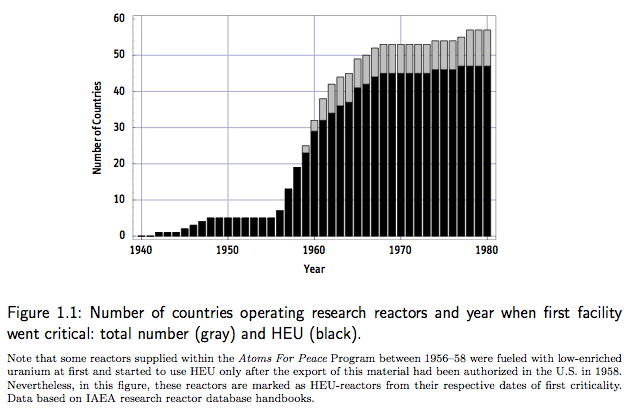 Eliminating HEU from the civilian nuclear fuel cycle therefore requires a two-pronged approach. First, legacy materials stemming from the former use in research reactors, which are usually still being stored at the respective reactor sites worldwide, have to be consolidated and, ultimately, down-blended to low enrichment. Second, the remaining operational HEU-fueled research reactors in the world have to be converted to low-enriched uranium to eliminate the demand for fresh HEU. The latter has significantly dropped since the creation of the Reduced Enrichment for Research and Test Reactors (RERTR) Program in 1978, but still amounts to about one metric tonne per year. Both areas have gathered considerable new momentum since 2002. Major national and international programs have been launched recently to carry out a complete global cleanout of highly enriched uranium and other high-risk materials. Similarly, for the first time, the conversion of all research reactors worldwide has been defined as an explicit objective with a target date for completion within a decade. However, while the global `cleanout' of HEU is an uncontroversial undertaking, the conversion of research reactors is a more complex technical and administrative process, because the interests of reactor operators and users are involved. Potential criteria to guide a conversion process include minimum reactor core modification, minimum changes in operational characteristics and neutron flux values, minimum licensing problems, minimum fuel cycle costs, etc. From a purely technical perspective, highly enriched fuel is always superior to low-enriched fuel due to the higher concentration of fissile U-235 and the lower parasitic absorption in U-238 --- both characteristics that however also explain the weapon-usability of HEU. To overcome this disadvantage of low-enriched fuels, the development of advanced high-density fuels for research reactors began within the framework of the RERTR program, raising effective uranium densities in the fuel several-fold compared to the initial 1.0--1.5 g/cm3 that were achievable until the 1980s (Figure 2. The availability of these fuels is a prerequisite for meeting most of the technical and economic criteria relevant in a conversion process. In 2002, a new potential fuel-type with an extraordinary uranium density of 16 g/cm3 (monolithic fuel) was discovered, which is now becoming the subject of an important international R&D-effort. 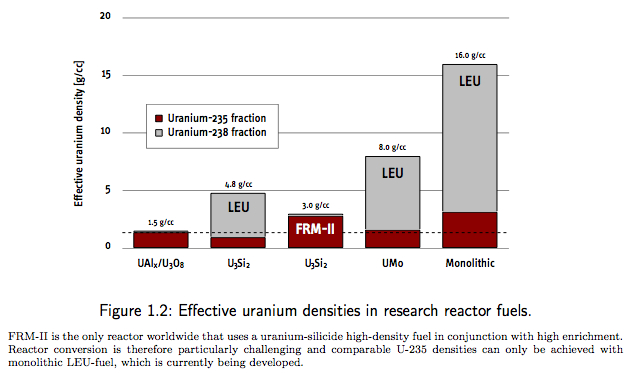 The new spirit and urgency of converting the remaining HEU-fueled reactors to low-enriched fuel, combined with the prospects of new ultra-high-density fuels, provides the main impetus and defines the basic scientific objectives for this thesis.
Several appendices provide supplementary information on proliferation risks associated with the use of nuclear-weapon materials in the nuclear fuel cycle, i.e. aspects that are only briefly addressed in Chapter 2. To appreciate and correctly assess these risks, some technical data and considerations on the weapon-usability of enriched uranium are discussed in Appendix A. Fundamental properties of HEU are compared to those of plutonium, which illustrates their respective proliferation-relevant characteristics and the need to address these two nuclear-weapon materials with specially designed nonproliferation strategies. Appendix B provides additional data on the plutonium production potential of certain reactor-types. Tables listing research reactors that are relevant in the conversion context are made available in Appendix C. The primary focus of this thesis is on modern high-flux reactors used for neutron beam research and the possibility of fueling these facilities with low-enriched uranium. Chapter 3 summarizes the basic requirements on reactors and instruments from a user's perspective. A relatively simple performance index is suggested using maximum thermal and fast neutron fluxes to characterize reactor performance for neutron beam research in more detail. This index will be used later to assess corresponding results of neutronics calculations. Chapter 4 introduces the primary classes of nuclear fuels that are (or have been) used in research reactors. Particular emphasis is placed on those fuels that are potentially relevant to the conversion of research reactors to low-enriched fuel, i.e. on high-density fuels developed specifically for that purpose. Data for selected materials and fuels that are used for the simulations in the main parts of the thesis are defined for reference purposes. Chapter 4 closes with a short overview of the status and the perspectives of high-density fuel development, summarizing current problems and perspectives as well as the R&D schedule for the next few years. Chapters 5, 6, and 7 are mainly dedicated to a presentation of the conceptional approaches and the methodology used for subsequent analysis. Virtually all calculations performed are based, at least partially, on results generated with the Monte Carlo neutron transport code MCNP, developed at Los Alamos National Laboratory, which is generally considered the reference code for neutronics calculations. Designing detailed and faithful three-dimensional reactor models for MCNP is therefore a prerequisite for reliable and accurate results. Mathematica is used as the primary tool to generate MCNP input decks for single element reactors, and Chapter 5 introduces the conceptual approach to guarantee the most faithful models. The basic MCNP input decks generated with this approach can be used for neutronics calculations aimed at determining `static' properties of the reactor under consideration. This includes, in particular, the maximum neutron flux, which is generally among the most important characteristics of a research reactor used for neutron beam research. The second fundamental use of Mathematica is in the preparation of highly-accurate burnup calculations for single element reactors and Section 5.2 presents the essential elements of this system. In using a power density profile generated with MCNP for the fuel plate at BOL, a search-algorithm programmed in Mathematica identifies an optimum structure of burnup zones (adaptive cell structure, ACS) and generates the corresponding MCNP input deck. Due to the associated complexity of the required cell- and surface-cards, this approach would be practically infeasible without using a modern technical computing environment, such as Mathematica. The functional elements provided by Mathematica are the basis for the computational system developed in the framework of this thesis. This system, which is designated M3O (Mathematica-MCODE-MCNP-ORIGEN2), is specifically designed for neutronics calculations for single element reactors. Prediction of the irradiation behavior of nuclear fuels is one central category of results produced with M3O. The fundamental burnup equations are therefore presented in Chapter 6, where practical strategies of solution of these equations are introduced and justified. In addition, Chapter 6 presents the individual components of this system and introduces their respective principles and functions. Particular emphasis is on the Monte Carlo Method, being the central technique for all calculations performed in the framework of this thesis. As indicated, and in addition to the overarching role of Mathematica, M3O contains separate control- and physics-codes, which are MCODE, MCNP, and ORIGEN2. Here, MCODE is a linkage-code developed at MIT that automates sophisticated burnup calculations in combining the neutron transport code MCNP and the point-depletion code ORIGEN2 (Oak Ridge National Laboratory). With the computational system M3O available, and equipped with the ACS formalism for optimum burnup-zones, comprehensive neutronics calculations for arbitrary single element reactors can be performed. Chapter 7 is included to address and study some fundamental aspects of neutronics calculations of this type. To this end, the previously mentioned generic single element reactor (GSER) is introduced, which is used subsequently to perform a series a comparative calculations targeted at a general performance assessment of the system. Particularly, a sensitivity analysis for important parameters of ACS burnup calculations is performed, and precautions that may have to be taken to guarantee reliable results are identified. Some aspects relevant to all neutronics calculations (such as neutron flux normalization) are discussed. Sample MCNP and MCODE input decks for the generic single element reactor discussed in Chapter 7 are reproduced in Appendices D and E for reference purposes. Chapter 8 leads over to the last major part of this thesis, which is dedicated to an assessment of the potential of high-density fuels for conversion of research reactors to low-enriched fuel. The case of FRM-II is used as the primary test-case for this analysis because its conversion will gauge the limits of any LEU fuel. Specifically, Chapter 8 focusses upon a detailed discussion and analysis of the current HEU design, which en passant demonstrates the versatility and accuracy of M3O for complex neutronics calculations. A brief discussion of results obtained for some earlier conversion options for the reactor, which have been defined by Argonne National Laboratory in 1999, closes Chapter 8. M$^3$O results are compared to the data published by ANL. Before turning to the identification of specific conversion options based on monolithic fuels, a method to optimize single element reactor performance is proposed in Chapter 9. Based on the linear programming technique and using MCNP-based perturbation calculations, this approach can be used to identify a set of reactor design variables that optimizes an objective function (usually, the thermal neutron flux), while simultaneously satisfying a pre-defined set of constraint conditions. Prior to presenting the details of this optimization tool, some general aspects of research reactor design are re-introduced to motivate the specific approach. The discussion focusses upon the original design principles of MTR-type reactors as well as on specific requirements of reactors for neutron beam research. Chapter 10 applies the optimization tool to the case of FRM-II, using ultra high-density monolithic fuel, while reducing the uranium enrichment as far as possible. The optimization process proceeds in two steps. First, preliminary conversion option candidates are identified (type A options). These options satisfy some minimum design criteria, particularly the cycle length requirement, but they are not optimized for best overall performance. The most promising candidate options are then used as a zeroth-order design and subject to the optimization process based on the linear programming technique introduced in Chapter 9. As a result, the final monolithic fuel conversion options for FRM-II are identified (type B options). To conclude and complement the analysis, in Chapter 11, the simple performance index proposed in Chapter 3 is applied to the optimized conversion options identified for FRM-II. With these last results, conclusions and potential further work are formulated in Chapter 12.
Copyright 2005, Alexander Glaser |